

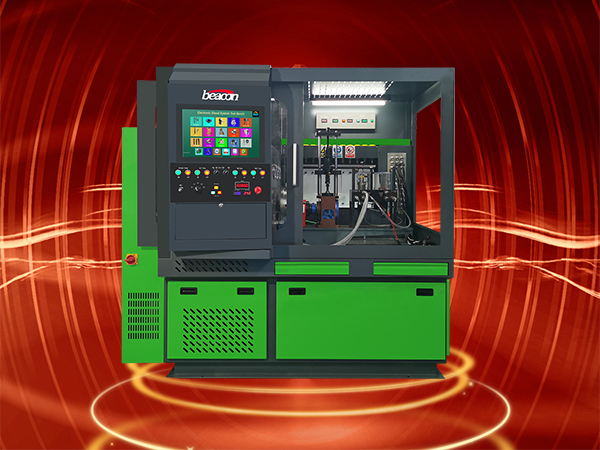
As the core component of the fuel system, the diesel fuel injection pump's malfunction directly impacts engine power, fuel consumption, and emissions. The following outlines diagnostic methods and key recommendations for the BEACON CR919 fuel injection pump test bench.
一、Common Fault Phenomena and Their Causes
|
fault phenomenon |
Key possible reasons |
|
Startup difficulty / Cannot start |
Plunger/outlet valve wear, insufficient fuel supply pressure; fuel injection timing deviation; low-pressure fuel line intake/blockage; electronic control pump solenoid valve/regulator failure |
|
Decreased power output and weak acceleration |
Insufficient fuel supply (ratchet jam, plunger wear); high-pressure fuel line leakage; governor spring failure |
|
Black/white smoke coming from the exhaust pipe |
Black smoke: excessive fuel injection; White smoke: poor fuel atomization (plunger/sprayer failure) |
|
unsteady speed / wandering |
Slow governor response (oil contamination/damage); fuel water content/impurities |
二、Diagnostic Procedures and Methods
System inspection: Check the fuel tank level, ensure no leaks in the fuel lines, and confirm the filter is not clogged.
Manual oiling of the oil pump: When the oil pump requires manual oiling, high resistance or oil-free operation is typically caused by a clogged filter or air intake in the oil circuit.。
Auditory assessment: The fuel injection pump should produce a regular "click" sound, with abnormal noises indicating potential plunger/bearing damage.。
Low-pressure oil circuit: Measure the outlet pressure of the oil pump using a pressure gauge, with a standard range of 0.2–0.6 MPa. A reading below this range typically indicates a fault in the oil pump or filter.。
High-pressure oil circuit: Disconnect the high-pressure oil pipe and install a dedicated gauge. The idle pressure should be 15~25 MPa, and the high-speed pressure should be 60~120 MPa. A low reading indicates a plunger/outlet valve leak.。
Static timing: Align flywheel and pulley marks, verify the relative position between the fuel injection pump camshaft and crankshaft。
Dynamic Timing: Measure the injection timing with a strobe light/timing instrument, and adjust the installation angle if deviation is detected。
Cylinder isolation method: sequentially loosen the high-pressure fuel line of each cylinder. If the rotational speed remains unchanged after fuel cutoff, the cylinder is under-supplied with fuel.。
Quantitative testing: Disassemble the injector to measure fuel injection volume per cylinder, with deviation <5%, and compare against standard values for evaluation。
Mechanical governor: Check spring force, fly hammer wear, and manually pull throttle to measure response sensitivity。
Electronic speed controller: The diagnostic tool reads fault codes and calibrates sensors such as RPM and throttle position.。
Sealing inspection: Manual pump oiling of the oil pipe revealed oil leakage from the oil valve seat; in severe cases, plunger/outlet valve replacement is required.。
三、Core rationale for recommending the BEACON CR919 test bench
The CR919 is a comprehensive diagnostic system covering all types of fuel injectors and fuel pumps, specifically designed for precise fault detection and efficient maintenance. Its key advantages are as follows::
Compatible with mainstream brands including Bosch, Denso, Delphi, Caterpillar, and Cummins, supporting common rail pumps, VE/VP37/VP44/RED4 electronic control pumps, as well as traditional inline pumps and EUI/EUP/HEUI medium-pressure common rail systems.。
Capable of testing solenoid valves, piezoelectric injectors, and even special common rail pumps like CAT 320D, effectively addressing maintenance challenges across multiple brands and models.。
With the original factory-standard database, it delivers test accuracy matching the original equipment, enabling precise measurement of key parameters including fuel injection volume, return oil volume, seal pressure, and response time.。
Supports IMA encoding generation and injector compensation code calibration, compatible with Bosch and other high-end systems, ensuring stable performance after maintenance.。
With integrated auto-testing, data collection, and report analysis, one-click operation enables comprehensive monitoring of rotational speed, rail pressure, flow rate, and other parameters, doubling efficiency.。
Supports simultaneous multi injector drive testing (up to 6), shortens maintenance cycles for individual units, and reduces downtime losses。
Capable of simulating ECU signals to precisely control common rail pump metering units, rail pressure valves, and injectors, with adjustable PWM/current waveforms for complex electronic control logic.。
Supports network remote upgrades, with data and features updated in sync with industry standards, ensuring diagnostic capabilities remain up-to-date over the long term。
With a rated power of 15kW, the robust and durable housing operates reliably in temperatures ranging from-10°C to 50°C, meeting continuous workshop operation requirements.。
Complies with CE international safety standards, featuring end-to-end safety protection to prevent risks such as high pressure and oil leakage.。
四、Maintenance Precautions
The BEACON CR919 test bench enables rapid troubleshooting of fuel injection pump issues through a systematic process: initial inspection → stress testing → timing calibration → fuel supply detection → governor,seal testing. With its core advantages of full compatibility, high precision, and operational efficiency, this platform has become the go-to solution for resolving complex faults in both conventional and electronically controlled pumps. It significantly enhances maintenance efficiency and quality while supporting diverse diesel engine repair scenarios.。
 English
 Русский
 Español